

Description
Size: Medium-large sized parrot, 251-349mm (in length); 260-329g
Plumage: Sexually dimorphic
Threats: Several factors are considered to have caused the decline of the Cape Parrot. These include forest degradation, food and nest-site shortages, low recruitment, removal of birds from the wild for the caged bird trade, and disease (particularly Psittacine Beak and Feather Disease) (Wirminghaus et al. 1999, 2000a).
Distribution: South African endemic. Only occurs in Afrocarpus and Podocarpus Afromontane forest patches from the Eastern Cape to southern KwaZulu-Natal (Wirminghaus 1997), with a relic population in Limpopo Province (Wirminghaus 1997). Although restricted to Afromontane forest patches, the birds are food nomads and are highly mobile; moving between yellowwood forest patches, visiting orchards and occasionally forests near the coast (Mboyti to Port St. Johns).
Vocalisation: The Cape Parrot’s loud, often continuous, calling makes it conspicuous; it is active for several hours after dawn and before sunset usually circling over the forest and calling loudly (Wirminghaus et al. 2000b).
Flock size: Varies with singletons, pairs, or groups of 5-6 birds observed. However at localised food sites flock size may increase to 20-70 birds (Wirminghaus et al. 2001a).
Geographical variation: No recognised races but possible variation in vocalisations (C.T. Downs, pers. obs.).
Measurements: wing (24m) 210-230 (218.3), (14f) 205-219 (210.5); tail (25m) 90-98.9 (94.8), (16f) 79.6-97.2 (89.3); tarsus (25m) 18.2-23.5 (21.7), (16f)19.9-22.4 (21.5); culmen (from edge of cere along curve to bill tip) (19m) 37-48 (40.8), (14f) 36-43 (38.3); mass (4 m) 295-329 (306), (3f) 260-328 (294).
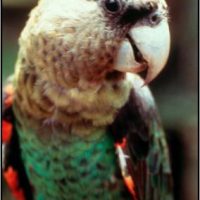
Bill colour old ivory; forecrown dark earth-brown; crown olive-green; collar, nape and upperchest yellow-green; chin and throat orange-brown; cheek and earcoverts olive-green to yellow green; lore matt black; mantle colour (area between wings) dark green; edge of scapulars dark oily green; edge of upper wing coverts dark green; flight and tail feathers darkslate; shoulder edge orange-red; back, rump, upper-tail coverts, under-tail coverts, flank, belly and lower chest blue-green; tibio-tarsal joint orange-red. Aberrant yellow wing feathers are sometimes observed.

Differs from male with varied forecrown plumage patterns, some having orange across the forehead and others having none. Males completely lack this colouration.

Both sexes with orange-red colour on the forehead in their first plumage, but only have red on the edge of the wing when they moult to adult plumage. The colour is more salmon pink and extends further on the crown in juveniles than in adults. At 8-10 months this colour is replaced in males with the hood plumage colours.