
Breeding biology
Mating system: Appears to be solitary, non-territorial nester. Degree of mate fidelity unknown but appears high although will take a new partner if mate dies in captivity. During courtship a typical male sequence is a quick wing-raise on arrival at a snag, then stretching of the wing (right then left) over a tail-extension, followed by stretching of the leg, rattling of the feathers, then looking around before half wing-raising with a tail-wag. Alternatively males give a tail-wag with the wings back, then do a wing extension followed by a head bob and a mandible rattle. The female responds with a wing stretch followed by a right wing or tail stretch. The male responds with a wing clip, a tail wag, and then a right wing extension (Wirminghaus et al. 2000a).
Laying dates: Breeding usually occurs from August to February, but can occur in other months particularly in captive birds (Wirminghaus et al., in press b). In the Eastern Cape and KwaZulu-Natal breeding in the Cape Parrot has occurred at varied times during the year (Mackworth-Praed & Grant 1962; Clancey 1964; Dean 1971).
Incubation: By the female and lasts 28-30 days.
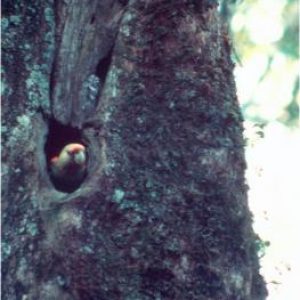
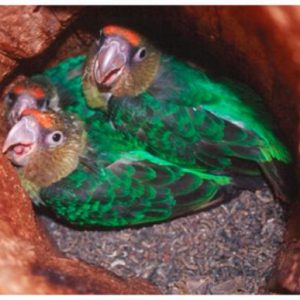
Development and care of young: At first nestlings have a pink appearance, covered with a sparse white down which gets thicker as the nestlings grow older. Bills have a distinct egg tooth. At 15 days old, pin feathers begin appearing on the forehead. At about 35 days of age, green tail feathers begin to break free of the quills. When chicks emerge from the nest, each resembles an adult female in colouring, with coral pink foreheads (Wirminghaus et al., in press b). First moult begins after 5-7 months. Time taken to moult into mature plumage is variable in both sexes. Chicks solicit food by chirping continually until fed. As chicks grow, they appear at the hole entrance and give ‘zeek-zeek’ calls (Wirminghaus et al., in press b).
Both parents attend the nest and regurgitate food to the young. The female spends more time in the nest than the male. Nestlings fledge asynchronously.
After fledging (55-79 days), chicks remain in groups with their parents and continue to be fed by regurgitation by both parents. Food given to chicks includes the kernels of P. falcatus and seeds of Acacia mearnsii (Wirminghaus et al., in press b). There is much vocal contact between fledglings and adults. When leaving the nest, both parents appear cautious before flying off.
Breeding success: Dueting pairs did not appear to defend nest sites but occasionally chased other avian frugivores away. There was no destruction of any observed clutches or broods by predators. Nesting requirements suggest that nest-sites are limiting (Wirminghaus et al., in press b), as few nests have been found and consequently there is little recruitment (Wirminghaus et al., in press b).